
Product Review
Saint Ignatius Loyola, the founder of the Jesuits, espoused the ideal of becoming "contemplatives in action." He was convinced that contemplation (the deep awareness and appropriation of the unconditional love of God) should affect our actions, and that our actions need to be brought back to contemplation.
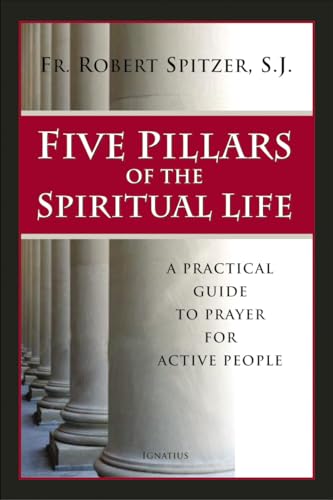
These five dimensions of the spiritual life: (1) the Holy Eucharist, (2) spontaneous prayer, (3) the Beatitudes, (4) partnership with the Holy Spirit, and (5) the contemplative life itself, generally do not develop simultaneously or even in parallel ways. Some develop very quickly, but do not achieve significant depth; while others develop quite slowly, but seem to be almost unending in the depth of wisdom, trust, hope, virtue, and love they engender. The best way of explaining this is to look at each of the pillars individually.
Before doing this, however, it is indispensable for each of us to acknowledge (at least intellectually) the fundamental basis for Christian contemplation, namely, the unconditional Love of God. Jesus taught us to address God as Abba. If God really is Abba; if His love is like the father of the prodigal son; if Jesus’ passion and Eucharist are confirmations of that unconditional Love; if God really did so love the world that He sent His only begotten Son into the world not to condemn us, but to save us and bring us to eternal life (Jn 3:16-19); if nothing really can separate us from the love of God in Christ Jesus (Rm 8:31-39); and if God really has prepared us "to grasp fully, with all the holy ones, the breadth and length and height and depth of Christ's love, and experience this love which surpasses all understanding, so that we may attain to the fullness of God Himself" (Eph 3:18-20), then God's love is unconditional, and it is, therefore, the foundation for unconditional trust and unconditional hope. There can be nothing more important than contemplating, affirming, appropriating, and living in this Unconditional Love. This is the purpose of contemplation; indeed, the purpose of the spiritual life itself.


