
Product Review
Whether building a road or fighting a war, leaders from ancient Mesopotamia to the present have relied on financial accounting to track their state's assets and guide its policies. Basic accounting tools such as auditing and double-entry bookkeeping form the basis of modern capitalism and the nation-state. Yet our appreciation for accounting and its formative role throughout history remains minimal at best-and we remain ignorant at our peril. The 2008 financial crisis is only the most recent example of how poor or risky practices can shake, and even bring down, entire societies.
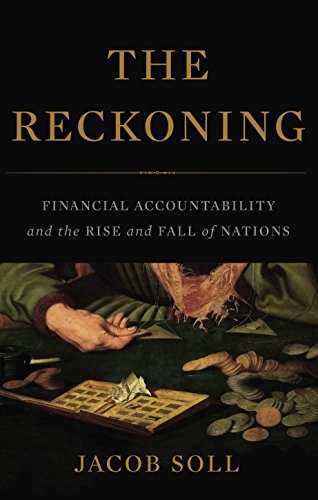
In The Reckoning, historian and MacArthur "Genius" Award-winner Jacob Soll presents a sweeping history of accounting, drawing on a wealth of examples from over a millennia of human history to reveal how accounting has shaped kingdoms, empires, and entire civilizations. The Medici family of 15th century Florence used the double-entry method to win the loyalty of their clients, but eventually began to misrepresent their accounts, ultimately contributing to the economic decline of the Florentine state itself. In the 17th and 18th centuries, European rulers shunned honest accounting, understanding that accurate bookkeeping would constrain their spending and throw their legitimacy into question. And in fact, when King Louis XVI's director of finances published the crown's accounts in 1781, his revelations provoked a public outcry that helped to fuel the French Revolution. When transparent accounting finally took hold in the 19th Century, the practice helped England establish a global empire. But both inept and willfully misused accounting persist, as the catastrophic Stock Market Crash of 1929 and the Great Recession of 2008 have made all too clear.
A masterwork of economic and political history, and a radically new perspective on the recent past, The Reckoning compels us to see how accounting is an essential instrument of great institutions and nations-and one that, in our increasingly transparent and interconnected world, has never been more vital.
In The Reckoning, historian and MacArthur "Genius" Award-winner Jacob Soll presents a sweeping history of accounting, drawing on a wealth of examples from over a millennia of human history to reveal how accounting has shaped kingdoms, empires, and entire civilizations. The Medici family of 15th century Florence used the double-entry method to win the loyalty of their clients, but eventually began to misrepresent their accounts, ultimately contributing to the economic decline of the Florentine state itself. In the 17th and 18th centuries, European rulers shunned honest accounting, understanding that accurate bookkeeping would constrain their spending and throw their legitimacy into question. And in fact, when King Louis XVI's director of finances published the crown's accounts in 1781, his revelations provoked a public outcry that helped to fuel the French Revolution. When transparent accounting finally took hold in the 19th Century, the practice helped England establish a global empire. But both inept and willfully misused accounting persist, as the catastrophic Stock Market Crash of 1929 and the Great Recession of 2008 have made all too clear.
A masterwork of economic and political history, and a radically new perspective on the recent past, The Reckoning compels us to see how accounting is an essential instrument of great institutions and nations-and one that, in our increasingly transparent and interconnected world, has never been more vital.


