Product Review
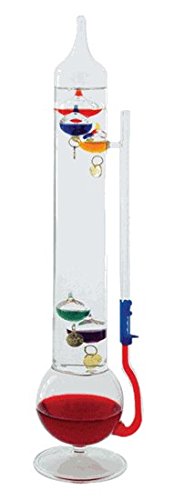
The Galileo thermometer consists of a sealed glass tube that is filled with fluid (paraffin oil) and several floating bubbles. The bubbles are glass spheres filled with a colored liquid mixture.
- The Galileo thermometer consists of a sealed glass tube that is filled with fluid (paraffin oil) and several floating bubbles. The bubbles are glass spheres filled with a colored liquid mixture.
- Attached to each bubble is a little metal tag that indicates a temperature. These metal tags are calibrated counterweights. The weight of each tag is slightly different from the others. Since the bubbles are all hand-blown glass, they aren't exactly the same size and shape.
- The bubbles are calibrated by adding a certain amount of fluid to them so that they have the exact same density. So, after the weighted tags are attached to the bubbles, each differs very slightly in density (the ratio of mass to volume) from the other bubbles, and the density of all of them is very close to the density of the surrounding fluid.
- The concept that 'decreasing atmospheric pressure predicts stormy weather' was postulated by Lucien Vidie -- and it's the basis for a weather prediction device called a storm glass or liquid barometer. It consists of a glass container with a sealed body, half filled with water.
- A narrow spout connects to the body below the water level and rises above the water level, where it is open to the atmosphere. When the air pressure is lower than it was at the time the body was sealed, the water level in the spout will rise above the water level in the body and when the air pressure is higher, the water level in the spout will drop below the water level in the body.