Product Review
Nutritional Profile of Dried Maca Root (Average 10 gram serving) Component per 10 g Amino Acids per 10 g Minerals per 10 g Protein 1-1.4 g Alanine 63.1 mg Calcium 25 mg Carbohydrates 6-7.5 g Arginine 99.4 mg Copper 0.6 mg Fats (lipids) 220 mg Aspartic acid 91.7 mg Iron 1.5 mg Fiber 850 mg Glutamic acid 156.5 mg Iodine 52 mcg Ash 490 mg Glycine 68.3 mg Manganese 80 mcg Sterols 5-10 mg Histidine 41.9 mg Potassium 205 mg Calories 32.5 HO-Proline 26.0 mg Sodium 1.9 mg Isoleucine 47.4 mg Zinc 380 mcg Leucine 91.0 mg Vitamins per 10 g Lysine 54.5 mg Fats/Lipids per 10 g B2 39 mcg Methionine 28.0 mg Linoleic 72 mcg B6 114 mcg Phenylalanine 55.3 mg Palmitic 52 mcg C 28.6 mg Proline 0.5 mg Oleic 24.5 mcg Niacin 565 mcg Sarcosine 0.7 mg Serine 50.4 mg Threonine 33.1 mg Tryptophan 4.9 mg Tyrosine 30.6 mg Valine 79.3 mg
- Maca is a plant that grows in central Peru in the high plateaus of the Andes mountains. It has been cultivated as a vegetable crop in Peru for at least 3000 years. Maca is a relative of the radish and has an odor similar to butterscotch. Its root is used to make medicine. The root of the Maca plant is often used to balance hormones and naturally enhance libido function. Maca plants will not grow well in hot climates but can be grown in the winter months of most northern latitudes.
- MACA Seeds should be sown in winter or when cold, just under the surface of a well drained potting mix, which can include equal parts perlite:potting mix:vermiculite and some sand. Once the seedlings emerge (7 days), they can either be thinned out or left until they are big enough to withstand transplanting. They can also be directly sown into the garden to avoid transplant shock and this is the preferred method of raising from seed. Full sun with adequate water but can take dry periods well as it is used to poor soils in the mountains of Peru. Likes sandy soil, drought tolerant once established. Biennial, harvest roots in 2nd year.
- Maca is a hardy perennial plant cultivated high in the Andean Mountain at altitudes from 11,000-14,500 feet. The area where Maca is found high in the Andes is an inhospitable region of intense sunlight, violent winds and below freezing weather. With its extreme temperatures and poor rocky soil, the area rates among the world's worst farmland, yet over the centuries, Maca learned to flourish under these conditions. Maca was domesticated about 2000 years ago by the Inca Indians and primitive cultivars of Maca have been found in archaeological sites dating as far back as 1600 B.C.
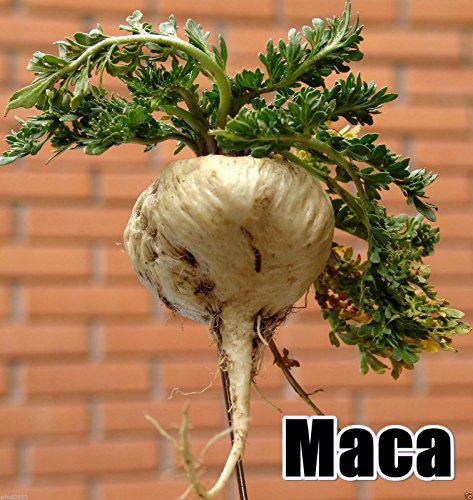
- Maca has a low-growing, mat-like stem system which at times goes almost unnoticed. Its scalloped leaves lie close to the ground and it produces self-fertile small off-white flowers. The part used is the tuberous root which is pear shaped, up to 8 cm/3 inches in diameter and ranging from off-white to golden in colour usually, with the occasional purple one. Although it is a perennial, it is grown as an annual, and 7-9 months from planting are required to produce the harvested roots.. To the Andean Indians, Maca is a valuable commodity. Because so little else grows in the region, Maca is often traded with communities at lower elevations for other staples like rice, corn, and beans.
- Native Peruvians have traditionally utilized Maca since before the time of the Incas for both nutritional and medicinal purposes. Maca is an important staple in the diets of the people indigenous to the region since it has the highest nutritional value of any food crop grown there. It has 59% carbohydrates, 10.2% protein, 8.5% fibre and 2.2% lipids. It has a large amount of essential amino acids and higher levels of iron and calcium than potatoes. Maca contains important amounts of fatty acids including linolenic, palmitic and oleic acids. It is rich in sterols and has a high mineral content as well. In addition to its rich supply of essential nutrients, Maca contains alkaloids, tannins and saponins. A chemical analysis conducted in 1981 showed the presence of biologically active aromatic isothiocyanates, especially p-methoxybenzyl isothiocyanate, which have reputed aphrodisiac properties.